Why Microsoft’s low-code platform is quietly becoming one of the most useful tools a business can have, and what it means for your organization.
Short answer: For most internal business processes, yes, Power Apps is worth it. It turns spreadsheets, email chains and aging Access databases into real apps in weeks instead of months, and many organizations already own part of it through Microsoft 365. It isn’t free for every scenario and it isn’t right for every project, so here’s the full picture.
Here’s a scenario I’ve seen dozens of times. A business runs a process on email threads, sticky notes and a shared Excel file nobody trusts. It works, barely, until the day it doesn’t. A record gets overwritten. A deadline gets missed. An audit turns up gaps nobody can explain.
The fix isn’t a six-figure ERP project. It’s a Power App, built in days or weeks. That’s the case in a nutshell: real applications, real data and real business logic, delivered faster and cheaper than custom software. But there’s more to it than speed.
What Power Apps Can Replace
| What you’re using now | What it becomes in Power Apps |
|---|---|
| A shared Excel tracker | An app with one trusted record per item, change history and permissions |
| Approvals over email | A request form with automatic routing and status tracking in Power Automate |
| Paper or PDF inspection forms | A mobile app that captures photos, GPS and signatures in the field |
| An Access database on a shared drive | A web and mobile app on SharePoint or Dataverse (see Migrating Access to Power Platform) |
| Smartsheet or other add-on tools | Apps inside the Microsoft 365 you already pay for (see Power Platform vs Smartsheets) |
You Probably Already Own Part of It
The most underappreciated fact about Power Apps is that many organizations already have it. Most Microsoft 365 business plans include Power Apps for apps that use Microsoft 365 data and standard connectors, like SharePoint lists, Excel, Outlook and Teams.
That means your first apps may cost nothing extra in licensing. The question shifts from “can we afford this?” to “why haven’t we started yet?”
To be clear about the limits: apps that use Dataverse, premium connectors (like SQL Server, Oracle or Salesforce) or on-premises data need a Power Apps Premium license for each user. Microsoft explains the split in its Power Apps licensing overview. A good consultant will tell you upfront which tier your app needs, and design to the lower tier when it makes sense.
It’s Not a Toy. It’s Enterprise-Grade.
Low-code has a reputation problem. Critics dismiss it as a way to build simple forms. Power Apps doesn’t deserve that label. Built on Dataverse, it supports role-based security, complex relational data, business rules, offline use and connections to almost any data source.
The big companies have noticed: Microsoft reports that 97% of Fortune 500 companies use the Power Platform.
I’ve personally built Power Apps for field service dispatch with geocoding, clinical incident reporting across multi-site healthcare organizations, and financial offer code management tied to Oracle databases. None of these are toy use cases.
Real-world example: A field service company needed technicians to log jobs, capture GPS locations and sync with QuickBooks, all from their phones. We built it in Power Apps on Dataverse, with Power Automate connecting to the QuickBooks API. Total build time: three weeks, at a fraction of the cost of off-the-shelf alternatives. See more in our case studies.
The Ecosystem Multiplies the Value
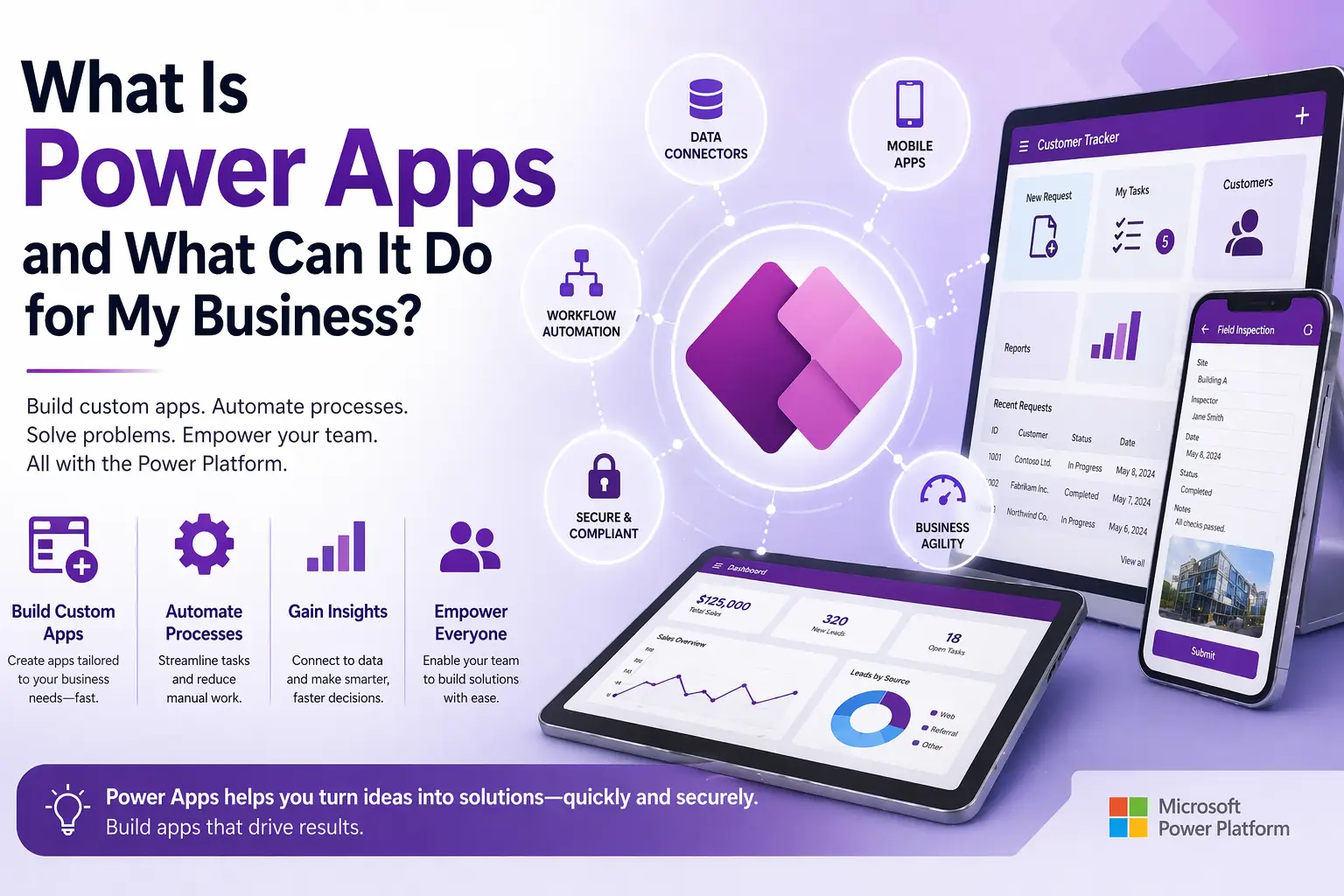
Power Apps doesn’t stand alone. It’s one part of a connected platform:
- Power Automate handles workflows, emails and approval routing.
- SharePoint stores documents.
- Dataverse manages structured data.
- Power BI turns your app data into dashboards.
Need an email when a form is submitted, or an approval chain? That’s Power Automate. Need a dashboard? Power BI connects natively. The platform handles integrations that would otherwise need custom code. If your team still relies on VBA for this kind of automation, our VBA vs Power Automate whitepaper compares the two.
The Talent Pool Is Growing, and So Are Expectations
Microsoft has invested heavily in Power Platform training and certification. There’s a large and growing community of developers, administrators and power users who know the stack. That means more people to hire, more consultants who can extend what you build, and more staff who can maintain it.
It also means expectations are rising. Organizations still running on spreadsheets are falling behind peers who automated the same processes years ago.
The Honest Limitations
A credible case includes the downsides. Power Apps isn’t the right tool when you need:
- Pixel-perfect design or a complex public-facing website
- Deep integration with non-Microsoft systems that lack good connectors
- Very low per-user cost at large scale, since Premium licenses and Dataverse storage add up
The platform also changes quickly, and a Microsoft update occasionally breaks something that worked yesterday. Ongoing Power Platform support helps here.
These are real considerations. But for most internal business apps, the ones living in spreadsheets, email chains and Access databases, Power Apps is the right answer. The limits are at the edges; the value is at the center. For a side-by-side with other options, see What Is the Best Replacement for Microsoft Access?
Have a process that’s begging for an app? Book a free diagnostic and we’ll tell you whether Power Apps fits and what it would cost to license.
Where to Start
The best first Power App solves a pain your team feels every day. Not a moonshot, just a slow, error-prone or invisible process:
- Submitting a request
- Tracking an approval
- Logging an inspection
Give that process a real interface connected to real data, and watch how fast the appetite for more grows. That’s how Power Platform adoption really happens: one well-built app at a time, each one making the case for the next.
If your starting point is an Access database, read Can You Build Access on Dataverse? and Is Microsoft Access Being Replaced? first.
Frequently Asked Questions
Is Power Apps free with Microsoft 365?
Partly. Most Microsoft 365 business plans let users build and run apps that use SharePoint, Excel, Outlook and other standard connectors. Apps that use Dataverse, premium connectors or on-premises data need a Power Apps Premium license per user.
How long does it take to build a Power App?
Simple apps can take days. A full business app with workflows and integrations typically takes a few weeks. The field service app above took three weeks.
Can Power Apps replace Microsoft Access?
For most business databases, yes. Power Apps adds web and mobile access, cloud data and better security. Very complex Access applications are often migrated in phases.
Is Power Apps good for small businesses?
Yes, especially if you already have Microsoft 365. Small businesses can often start with apps on SharePoint at no extra license cost, and add Premium licenses only for the users who need them.
Anthony Passeri, MBA, is the founder of Access Evolved and a certified Microsoft Access Expert with 21+ years of Access and relational database experience. He helps businesses keep critical Access databases running and modernize them to Power Platform or SQL Server. More about Anthony
Talk to an Access Expert
Not sure what this means for your database? Book a free diagnostic call. No sales pitch, just a straight conversation about what makes sense for your situation.
Phone: 623-267-5720
Email: info@accessevolved.com
Access Evolved | 19580 W Indian School Rd, Ste 105 #815, Buckeye, AZ 85396